SoSha Logo

TEAM WOLF

State Wolf Management Report Card

Share these posts and spread the word! 📣

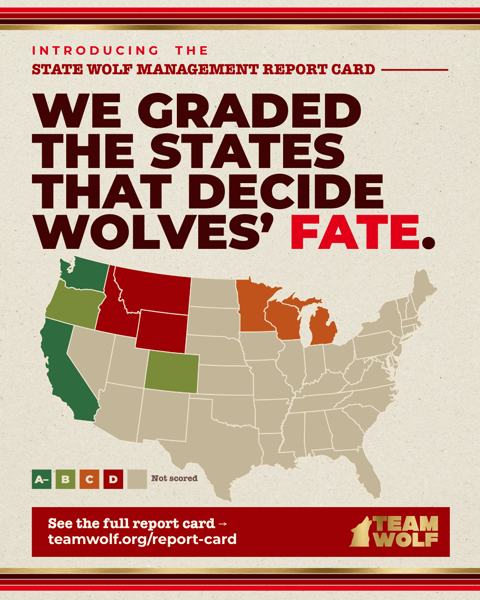
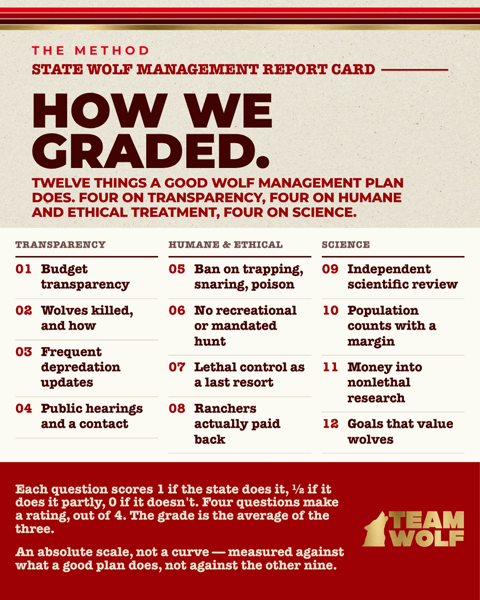
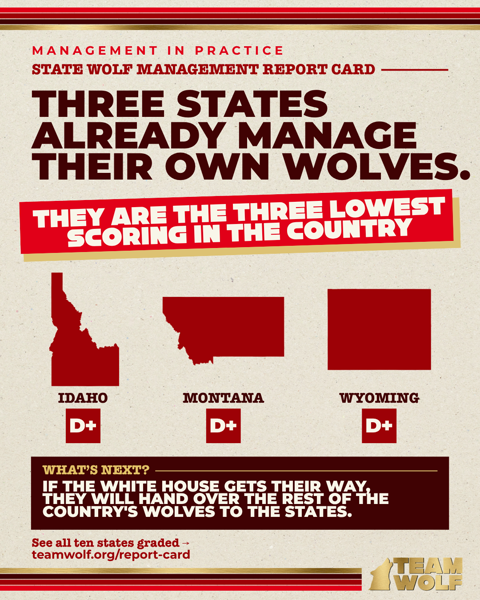
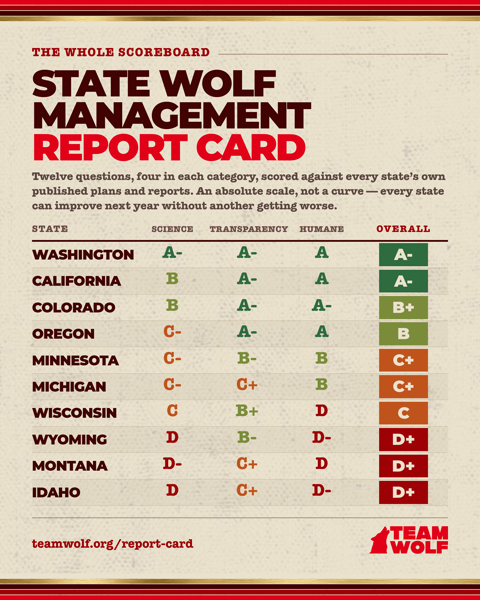
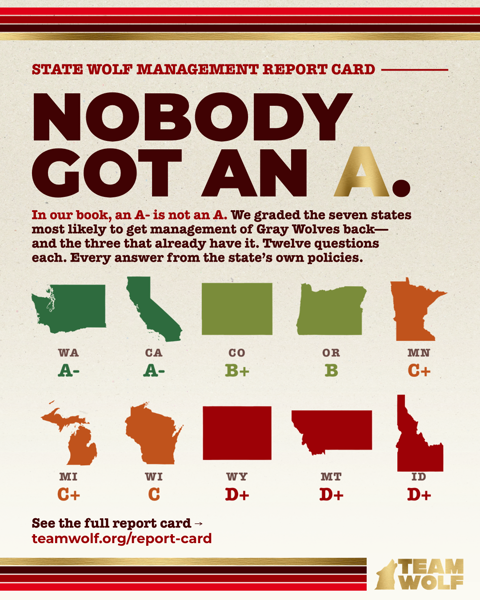
Team Wolf's first State Wolf Management Report Card is now live for 2026. Not including Mexican Wolves, an estimated 8,000 Gray Wolves are currently found in ten states. Three of those states already decide what happens to them; seven are next in line if federal protections are lost. Until today there was no way to compare what any of them actually do. So Team Wolf built a test and put the same twelve questions to all ten: four on science, four on transparency, four on how humanely a state treats wildlife. Every answer scored against that state's own published plans, reports and budgets. One point if it does it, half if partly, zero if not. An absolute scale, not a curve. Washington and California came closest at A−. The three states that already "manage" their own wolves—Idaho, Montana, and Wyoming—are the three lowest in the country. Nobody got an A. See the full report card at the link in bio. #TeamWolf

Select social network:
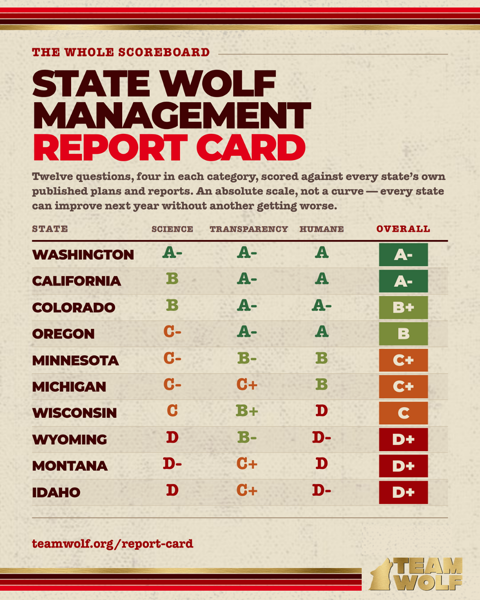
Team Wolf's State Wolf Management Report Card measures the ten states with established Gray Wolf populations against the same twelve questions, using each state's own published documents. This is every grade in every category, side by side. The same split shows up down the board. The four lowest-scoring states all do better on transparency than on humane and ethical treatment. They tell you what they are doing. It is what they are doing that earns the grade. Science is the weakest column of the three: six of the ten scored C− or lower, and no state beat an A−. Only three states clear a B in all three categories. Idaho, Montana and Wyoming — the three that already write their own rules for "managing" wolves — are the three lowest. See the full report card and every source behind it at the link in bio. #TeamWolf

Select social network:
Team Wolf's first State Wolf Management Report Card is out now and the closest any state came to an A was an A−. And it was only two states out of the ten. Washington bans trapping, runs no hunt, pays ranchers in full and names the outside scientists who reviewed its plan. It still left points on the table. Then Colorado B+, Oregon B, Minnesota and Michigan C+, Wisconsin C, and Idaho, Montana and Wyoming at D+. See the full report card and every source behind it at the link in bio. #TeamWolf

Select social network:
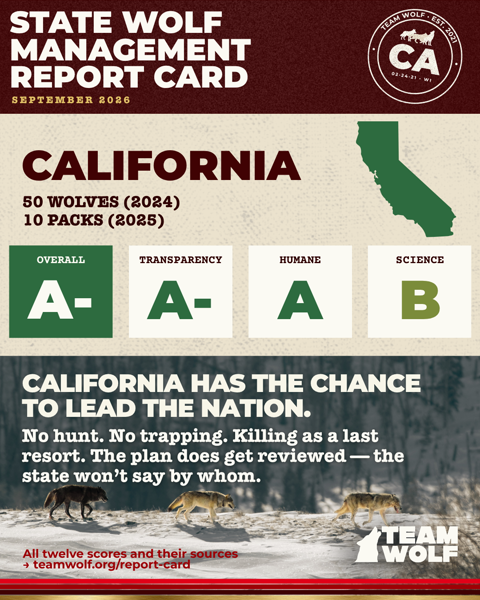
California does nearly everything right and will not say who checked its work. Team Wolf's State Wolf Management Report Card measures the ten states with established Gray Wolf populations against the same twelve questions, using each state's own published documents. Gray Wolves returned in 2011, when a single wolf called OR-7 walked across the Oregon border. The population is still small, around 50. California earns a straight A on ethical and humane treatment: trapping, snaring and poisoning banned, no hunt, non-lethal measures required first, compensation that works. The two gaps are both about showing your work. The plan goes through scientific review, but the reviewers are never named. And counts are published without a margin of error. Overall: A−. Tied for the best in the country, and two disclosures away from leading it. See the full scorecard and its sources at the link in bio. #TeamWolf

Select social network:
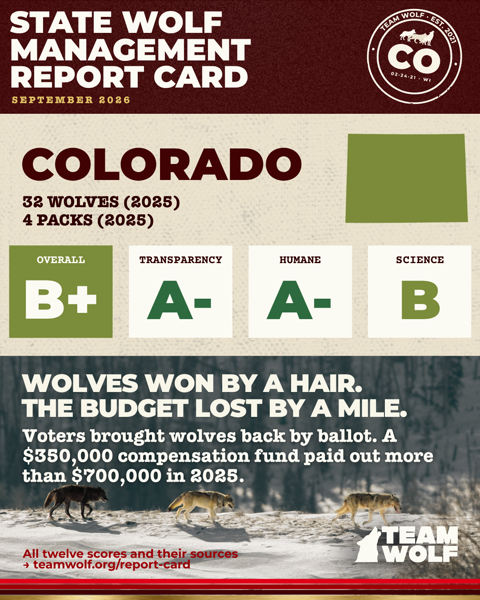
Colorado is the only state where the public voted wolves back, and it passed by less than two points. The program that vote created is strong. The money behind it is not. Team Wolf's State Wolf Management Report Card measures the ten states with established Gray Wolf populations against the same twelve questions, using each state's own published documents. Proposition 114 mandated reintroduction and the first wolves were released in December 2023. The population is small, around 32, and intensively tracked. No hunt. No trapping. Lethal control only after non-lethal measures are documented. The strain is in the fund. Compensation runs up to $15,000 an animal, but the fund was set at $350,000 and paid out more than $700,000 in 2025. Overall: B+. The program is good. The budget has to catch up to it. See the full scorecard and its sources at the link in bio. #TeamWolf

Select social network:
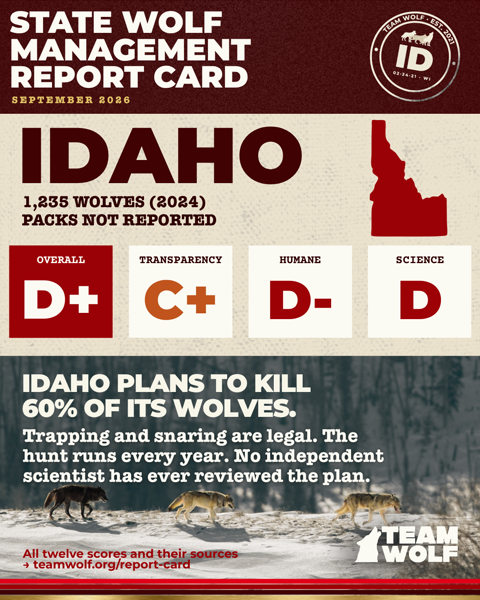
Idaho has roughly 1,235 Gray Wolves and is aiming to hunt that population down to about 500. That is a plan to kill about 60% of the wolves in the state. Team Wolf's State Wolf Management Report Card measures the ten states with established Gray Wolf populations against the same twelve questions, using each state's own published documents. Trapping and snaring are legal. Hunting season lasts almost all year. Lethal control is not a last resort in Idaho, it is the default method of "managing" wolves. No independent scientist has reviewed the plan. Overall: D+. One of the three lowest in the country, and one of only three states that currently manage their own wolves. See the full scorecard and its sources at the link in bio. #TeamWolf

Select social network:
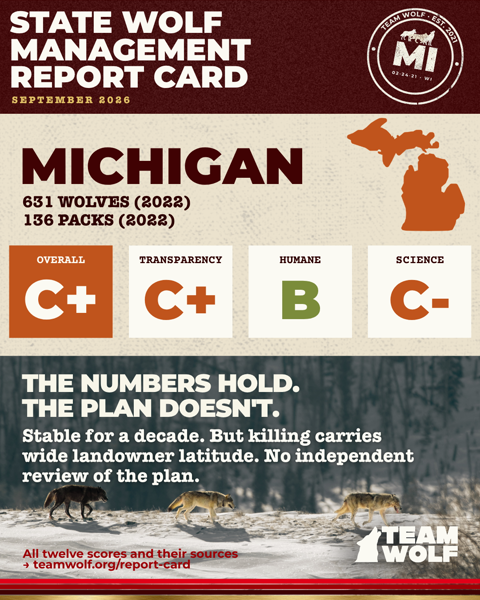
Michigan's wolves live almost entirely in the Upper Peninsula, and the count has barely moved in over a decade — around 631 at the last survey. The numbers hold. The plan behind them does not. Team Wolf's State Wolf Management Report Card measures the ten states with established Gray Wolf populations against the same twelve questions, using each state's own published documents. The gaps are procedural, which makes them easy to ignore and easy to fix. Lethal control is permitted for verified conflict with wide latitude for landowners. Kills are reported lumped together rather than by method. Losses are posted annually rather than as they happen. Counts are published without a margin of error. And no independent scientist has ever reviewed the plan. Overall: C+. Michigan is one honest audit away from a much better grade. See the full scorecard and its sources at the link in bio. #TeamWolf

Select social network:
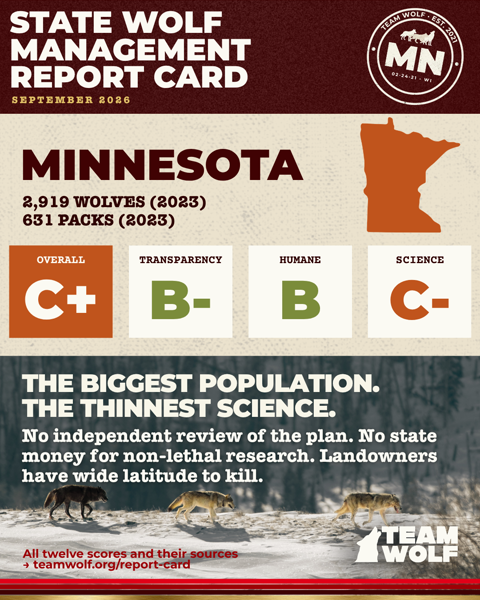
Minnesota is home to the largest wolf population in the contiguous United States, around 2,919 animals, and it is the one population that was never fully wiped out. If any state should have the deepest science behind its plan, it is this one. Team Wolf's State Wolf Management Report Card measures the ten states with established Gray Wolf populations against the same twelve questions, using each state's own published documents. It doesn't. No independent scientist has reviewed the plan. The state spends nothing on researching non-lethal ways to prevent livestock conflict. Counts are published without a margin of error. Minnesota does well on the ethical and humane criteria — no hunt, no trapping — which is why it still lands mid-table. Overall: C+. The biggest population deserves the best science, not the least. See the full scorecard and its sources at the link in bio. #TeamWolf

Select social network: